Solar energy has become one of the most widely discussed renewable energy sources in the world. From small rooftop systems to large solar farms, photovoltaic technology allows sunlight to be converted into usable electricity without burning fuel. But what actually happens inside a solar panel when sunlight is converted into usable electricity? Understanding how solar panels work becomes much easier when the process is broken down into simple steps.
Solar panels use photovoltaic cells, usually made from semiconductor materials such as silicon, to capture energy from sunlight. When sunlight strikes these cells, it causes electrical charges to move, producing direct-current electricity. An inverter then converts that electricity into alternating current, which can be used by homes, businesses, and electrical equipment.
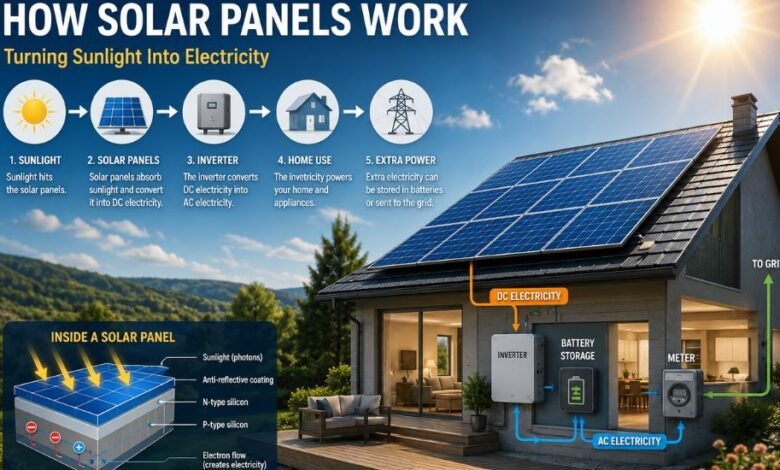
This guide explains how solar panels work to generate electricity, the physics behind the photovoltaic effect, how solar panels work on a house, and what happens after sunset. It also provides a simple diagram so beginners can understand the complete process.
How Solar Panels Work
Solar panels capture sunlight and use the photovoltaic effect to transform that light energy into usable electrical power.. A solar panel contains many photovoltaic cells, and each cell contains semiconductor material that responds to light.
When sunlight reaches a solar cell, photons from the sunlight transfer energy to electrons within the semiconductor. This energy allows electrons to move. The structure of the solar cell directs this movement so that an electrical current can flow through an external circuit.
The electricity produced by the photovoltaic cells is initially direct current, commonly called DC electricity. Since most household appliances use alternating current, or AC electricity, the DC power normally passes through an inverter before being supplied to the home’s electrical system.
Simply put, solar electricity is produced through the following basic steps:
Sunlight → Solar cells → DC electricity → Inverter → AC electricity → Appliances
The U.S. Department of Energy explains that photovoltaic cells use semiconductor materials to convert sunlight directly into electrical energy. This makes solar panels fundamentally different from technologies that generate electricity by burning fuel or using mechanical turbines.
How Solar Panels Work Simple Explanation
For someone completely new to solar energy, the easiest explanation is to imagine a solar panel as a device that catches energy from sunlight and turns it into electricity.
The process happens in several stages:
- Sunlight reaches the solar panel.
- Solar cells absorb energy from sunlight.
- The energy causes electrons to move inside the cells.
- The movement of electrons produces DC electricity.
- An inverter converts DC electricity into AC electricity.
- The electricity can then power household appliances.
Think of sunlight as the energy source and the solar cell as the device that converts that energy into electrical power.
The panel itself does not need to burn anything to produce electricity. It simply uses the energy carried by sunlight. This is one of the reasons photovoltaic solar technology is considered a renewable energy technology.
How Solar Panels Work Diagram
A simple diagram can make the entire process much easier to understand:
                    SUNLIGHT
                       ↓
                Photons reach
                solar panels
                       ↓
             ┌──────────────────┐
             │   SOLAR PANELS   │
             │  Photovoltaic    │
             │      Cells       │
             └────────┬─────────┘
                      ↓
                DC ELECTRICITY
                      ↓
             ┌──────────────────┐
             │     INVERTER     │
             │     DC → AC      │
             └────────┬─────────┘
                      ↓
                AC ELECTRICITY
                      ↓
             ┌──────────────────┐
             │      HOUSE       │
             │ Lights & Devices │
             └────────┬─────────┘
                      ↓
              Extra electricity
                 ↙         ↘
             BATTERY       GRID
This how solar panels work diagram shows the basic journey of energy from sunlight to a home.
A real solar installation can be more complicated because it may include multiple inverters, batteries, monitoring equipment, electrical protection devices, meters, and grid connections. However, the basic principle remains the same.
How Solar Panels Work to Generate Electricity
To understand how solar panels work to generate electricity, it is useful to look inside a photovoltaic cell.
Each photovoltaic cell relies on a specially engineered semiconductor material to convert sunlight into electrical energy. Silicon is one of the most commonly used materials because its electrical properties make it suitable for photovoltaic applications.
Sunlight consists of particles of electromagnetic energy called photons. When photons strike the semiconductor, some of their energy can be transferred to electrons.
These energized electrons can move through the material. The solar cell is specially engineered to create an internal electric field that helps separate electrical charges and directs their movement.
When the cell is connected to an external circuit, electrons can flow through that circuit. This flow of electric charge is an electrical current.
Many individual solar cells are connected together to form a solar module or panel. Multiple panels can then be connected to create a larger solar array capable of producing substantially more electricity.
Therefore, the electricity-generation process can be described as:
Photon energy → Electron movement → Electrical current → DC electricity
The inverter then converts the DC output into AC electricity for normal household use.
How Solar Panels Work Physics
The physics behind solar panels is known as the photovoltaic effect.
At the microscopic level, sunlight interacts with the semiconductor inside a photovoltaic cell. Silicon has a particular electronic structure that allows it to absorb photons of suitable energy.
A simplified explanation involves electrons and energy levels. Electrons normally occupy specific energy states within the material. When a photon provides enough energy, an electron can gain enough energy to become mobile.
This creates an electron and a corresponding “hole,” which behaves like a positive charge carrier. The solar cell’s internal electric field helps separate these charge carriers.
Once charges are separated, a voltage is created. If an external electrical circuit is connected, current can flow.
This is the fundamental physics of photovoltaic electricity.
What is the photovoltaic effect?
The photovoltaic effect occurs when sunlight triggers an electric current inside a solar cell.
It is important to understand that solar panels do not simply “store” sunlight. They continuously convert available light energy into electrical energy while suitable light reaches the photovoltaic cells.
Why is silicon used?
Silicon is a semiconductor and is widely used in solar cells. Its properties can be modified through a process called doping, which allows manufacturers to create semiconductor regions with different electrical characteristics.
The resulting structure helps establish the electric field required for photovoltaic operation.
This physics may sound complicated, but the basic idea is straightforward:
Light provides energy, the semiconductor responds to that energy, electrical charges are separated, and current can flow through a circuit.
How Do Solar Panels Work on a House?
A residential solar system usually places solar panels on a roof or another location with good exposure to sunlight.
During daylight hours, the panels produce DC electricity. That electricity is sent to an inverter, which converts it into AC electricity.
The AC electricity can then be used by appliances inside the house.
A typical home solar system may include:
- Solar panels
- Photovoltaic cells
- Inverter
- Mounting equipment
- Electrical wiring
- Safety and protection equipment
- Utility meter
- Optional battery storage
The process inside a home can be summarized as:
Sunlight → Rooftop panels → DC power → Inverter → AC power → Home appliances
If the solar system produces more electricity than the house is using, the extra energy may be stored in a battery or, depending on the system and local utility rules, exported to the electrical grid.
If the house requires more electricity than the solar panels are currently producing, electricity can come from a battery or the grid, depending on how the system is designed.
Do solar panels work automatically?
Yes. Once a properly installed system is operating, the photovoltaic panels generate electricity whenever suitable sunlight reaches them. The inverter and other system components manage the conversion and distribution of electricity.
However, solar production changes throughout the day. Production is generally higher when sunlight is stronger and lower during periods of weak sunlight, shade, or heavy cloud cover.
How Do Solar Panels Work at Night?
One of the most common questions is how do solar panels work at night.
Ordinary photovoltaic panels need light to produce their normal electrical output. At night, there is not enough sunlight reaching the panels to generate meaningful electricity through the conventional photovoltaic process.
However, a solar-powered home can still have electricity after sunset.
There are two common possibilities: battery storage and the electrical grid.
During the day, a solar system may produce more electricity than the house immediately needs. A battery system can store some of that energy for later use. After sunset, the stored electricity can be supplied to household appliances.
A grid-connected solar home can also receive electricity from the utility grid when its panels are not producing enough power.
Therefore, it is more accurate to say:
Solar panels generally do not generate their normal electricity at night, but a solar-powered house can still use electricity at night through batteries or the grid.
Do Solar Panels Work on Cloudy Days?
Solar panels can still produce electricity on cloudy days because daylight continues to reach the photovoltaic cells.
However, electricity production is generally lower when sunlight intensity decreases. The amount of reduction depends on factors such as cloud thickness, location, panel technology, shading, and overall weather conditions.
This is an important distinction between cloudy weather and nighttime.
At night, conventional PV panels receive very little usable sunlight. On a cloudy day, they can still receive diffuse daylight and therefore continue generating electricity.
Do Solar Panels Need Heat or Sunlight?
Solar panels primarily require light, rather than heat, to generate electricity.
A common misconception is that hotter weather automatically means better solar performance. In reality, photovoltaic modules can operate in cool conditions as long as sufficient sunlight is available. Very high temperatures can even reduce the electrical performance of many PV modules.
This means a cool, sunny day can be highly productive for a solar system.
The amount of electricity generated depends on many factors, including sunlight intensity, panel orientation, shading, temperature, system design, and equipment efficiency.
What Happens to Extra Solar Electricity?
A solar system does not always produce exactly the amount of electricity a home needs at every moment.
For example, during a sunny afternoon, a house might use relatively little electricity while the panels are producing a large amount. The resulting surplus can potentially be handled in several ways.
Battery storage
A battery can store surplus electricity for later use. This can be particularly useful after sunset or during periods when solar production is low.
Grid export
Some grid-connected systems can send surplus electricity to the utility grid. The exact arrangements, credits, compensation, and requirements vary according to location and utility regulations.
Immediate household use
The simplest option is to use solar electricity directly while it is being produced. Appliances operating during daylight can consume electricity generated by the panels.
Factors That Affect Solar Panel Performance
Solar panels do not produce the same amount of electricity every hour. Their output can change because of several factors.
Sunlight intensity
Stronger sunlight generally provides more energy for photovoltaic conversion.
Time of day
Solar production usually changes as the sun moves across the sky. Output is often lower in the morning and evening than around the period of strongest sunlight.
Weather
Clouds, rain, haze, and other weather conditions can affect the amount of sunlight reaching the panels.
Shading
Trees, buildings, poles, or other objects can block sunlight and reduce production.
Panel orientation and angle
The direction and angle of a panel influence how much sunlight reaches its surface.
Temperature
Temperature can affect photovoltaic performance. Higher temperatures do not necessarily mean higher electrical output.
Dirt and dust
Accumulated dirt or dust can block some sunlight from reaching the photovoltaic cells and may reduce performance.
How Many Solar Panels Does a House Need?
There is no single number that works for every home.
The required number of panels depends on factors such as:
- Household electricity consumption
- Available roof space
- Solar radiation in the location
- Panel wattage
- Panel efficiency
- Roof orientation
- Shading
- Desired level of energy independence
- Battery storage requirements
A home that consumes more electricity generally requires a larger solar system than a home with lower electricity consumption.
For this reason, a professional solar assessment should consider the home’s historical electricity usage and the site’s solar conditions rather than relying on a generic number of panels.
How Solar Panels Work: From Cell to Complete System
It is useful to distinguish between a solar cell, solar panel, and solar array.
A solar cell is the basic photovoltaic unit that converts light into electrical energy.
A solar panel or module contains multiple interconnected solar cells.
A solar array consists of multiple panels connected together to provide a larger electrical output.
The complete residential system then adds components such as an inverter, wiring, mounting hardware, electrical protection, monitoring equipment, and potentially batteries.
This is why saying “the solar panel makes electricity” is technically correct at a basic level, but the complete system is responsible for converting, controlling, and delivering that electricity in a useful form.
How Solar Panels Work PDF
People searching for how solar panels work PDF are often looking for a printable explanation, classroom resource, study guide, or technical reference.
A useful PDF on this subject should ideally include:
- A labeled solar-panel diagram
- Explanation of the photovoltaic effect
- Solar cell structure
- Sunlight-to-electricity process
- DC and AC electricity
- Inverter operation
- Residential solar-system layout
- Battery storage
- Nighttime operation
- Cloudy-weather performance
- Advantages and limitations
For students and beginners, a diagram-based PDF with short explanations is usually easier to understand than a highly technical engineering document.
Advantages of Solar Panels
Solar photovoltaic technology offers several important benefits.
First, sunlight is a renewable energy resource. Solar panels can generate electricity without burning fuel during operation.
Second, photovoltaic systems can be installed in many different settings, including residential rooftops, commercial buildings, and large solar farms.
Third, solar panels have no conventional moving mechanical components involved in the basic photovoltaic conversion process, which can simplify operation and maintenance.
Solar systems can also be combined with batteries, allowing some of the electricity produced during sunny periods to be used later.
Limitations of Solar Panels
Solar energy also has limitations.
The biggest limitation is that photovoltaic electricity production depends on available light. Production decreases during cloudy conditions and stops at night under normal operating conditions.
Solar installations also require suitable space and appropriate positioning. Shade can significantly affect output.
Battery storage can improve energy availability after sunset, but batteries add additional equipment and expense.
Finally, solar panels are manufactured products, so their production, transportation, installation, maintenance, and eventual recycling have environmental impacts that should be considered when evaluating the technology as a whole.
Frequently Asked Questions
How do solar panels work in one sentence?
Solar panels convert sunlight into DC electricity through the photovoltaic effect, after which an inverter can convert the electricity into AC power for household use.
How do solar panels generate electricity?
Photons from sunlight transfer energy to electrons in semiconductor material, allowing electrical charges to move and create an electric current.
Do solar panels work at night?
Conventional photovoltaic panels generally do not produce their normal electricity output at night because they need sunlight. Batteries or the electrical grid can provide power after sunset.
Can solar panels work on cloudy days?
Yes. Solar panels can still generate electricity from available daylight, although their output is generally lower than under strong direct sunlight.
Do solar panels work without an inverter?
A solar panel can produce DC electricity without an inverter, but a typical household solar system needs an inverter to convert DC electricity into AC electricity suitable for most household electrical loads.
Are solar panels the same as solar thermal panels?
No. Photovoltaic panels convert sunlight into electricity, while solar thermal systems primarily capture solar energy as heat.
Final Thoughts
Understanding how solar panels work does not require advanced physics. At its core, the process begins when sunlight reaches photovoltaic cells and transfers energy to electrons in a semiconductor. The movement of these charges creates DC electricity, which can then pass through an inverter and become usable AC electricity for a home or other electrical system. Solar panels generally need light to generate electricity, which is why their output changes throughout the day and is unavailable at night without another energy source.
For anyone researching renewable energy, learning how the photovoltaic effect works provides a useful foundation for understanding rooftop solar, batteries, inverters, solar farms, and modern home energy systems. If you want more easy-to-understand guides about technology, energy, and useful everyday topics, visit blogtrendnews, where readers can explore practical information presented in a simple and accessible format.