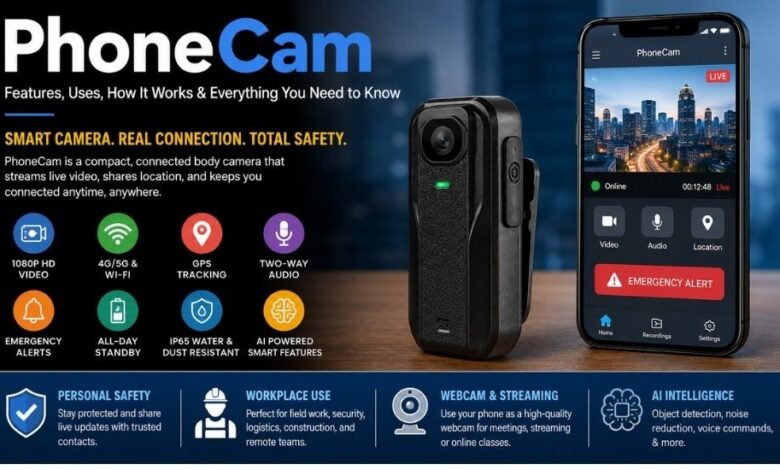
The word phonecam may sound simple, but it represents an important development in the history of mobile technology. A phonecam traditionally refers to a camera built into a mobile phone, allowing users to capture photographs and videos without carrying a separate digital camera. Over time, the idea has expanded considerably. Today, phonecam can also refer to applications that turn smartphones into webcams, camera-streaming tools, virtual cameras, and modern professional camera systems.
The development of phonecam technology has changed the way people take photographs, communicate, create content, work remotely, and share information. From the basic cameras found in early mobile phones to sophisticated smartphone camera systems featuring multiple lenses, artificial intelligence, stabilization, computational photography, and high-resolution video, phonecam technology has become an essential part of everyday digital life.
What Is Phonecam?
A phonecam is essentially a camera integrated into a mobile phone or smartphone. Instead of requiring a separate camera device, users can capture images and videos directly through their phones.
Early phonecams were relatively basic. They generally produced low-resolution photographs and offered limited features. Modern smartphone cameras, however, are significantly more advanced. Many devices now include multiple cameras designed for different purposes, such as wide-angle photography, ultra-wide images, portraits, optical zoom, and low-light photography.
The basic concept remains the same: a small camera sensor and lens system are integrated into a portable communication device. This combination allows people to capture and immediately store, edit, send, upload, or publish visual content.
The Evolution of Phonecam Technology
The history of the phonecam is closely connected to the development of mobile phones. Early mobile phones were primarily designed for voice calls and text messaging. As technology improved, manufacturers began adding cameras to mobile devices.
The first generations of camera phones offered relatively modest image quality compared with standalone digital cameras. However, convenience quickly became one of their biggest advantages. Users no longer needed to carry a separate camera for everyday photographs.
As mobile networks became faster and smartphones became more powerful, phonecams developed rapidly. Camera resolution improved, sensors became more capable, and manufacturers introduced additional lenses and software features.
The arrival of smartphones transformed phonecam technology even further. Touchscreens, powerful processors, mobile applications, cloud storage, social media platforms, and faster internet connections created an environment where capturing an image and sharing it could happen within seconds.
Today, a smartphone can function as a camera, video recorder, editing workstation, livestreaming device, scanner, webcam, and content-production tool.
How Does a Phonecam Work?
A phonecam works through a combination of hardware and software.
The primary hardware components include a camera lens, image sensor, processor, and supporting electronics. When light enters through the lens, it reaches the image sensor. The camera sensor captures incoming light and transforms it into digital data that the device can process.
The smartphone’s image processor then processes that information to create a photograph or video frame. Modern devices often use sophisticated software algorithms to improve exposure, colors, sharpness, dynamic range, and noise reduction.
Software plays an increasingly important role. Computational photography can combine multiple frames, adjust exposure, recognize subjects, enhance details, and produce an image that may look significantly better than a single raw sensor capture.
This is one reason modern phonecam systems can produce impressive results despite their small physical size.
Main Features of Modern Phonecams
Modern phonecams offer a wide range of features depending on the smartphone model.
High-Resolution Photography
Many modern phones provide high-resolution image capture. More pixels can provide additional detail, although resolution alone does not determine overall image quality.
The quality of the sensor, lens, image processing, lighting, and software all influence the final photograph.
Multiple Camera Lenses
Many smartphones now contain multiple rear cameras. A standard camera may be accompanied by an ultra-wide camera and one or more telephoto cameras.
Each lens serves a different purpose. Ultra-wide cameras are useful for landscapes and large groups, while telephoto cameras can help capture distant subjects.
Portrait Photography
Portrait modes use software and camera data to separate a subject from its background. The phone then creates a depth-of-field effect that resembles the appearance of a larger camera with a wide-aperture lens.
This feature has made professional-looking portrait photography more accessible to everyday users.
Night Photography
Low-light photography has traditionally been difficult for small smartphone cameras. Modern phonecams use larger sensors, improved image stabilization, brighter lenses, and computational techniques to produce brighter and more detailed night photographs.
Some devices capture multiple exposures and combine them into one final image.
Video Recording
Phonecams have also become powerful video-recording tools. Depending on the device, users may have access to high-resolution recording, slow motion, time-lapse, stabilization, cinematic modes, and advanced audio features.
For many creators, a smartphone is now sufficient for recording social media videos, tutorials, interviews, and short-form content.
Phonecam for Content Creators
One of the biggest impacts of phonecam technology has been on content creation.
Bloggers, influencers, journalists, business owners, educators, and independent creators can produce photographs and videos without purchasing a dedicated camera system.
A phonecam can be used to create:
- YouTube videos
- Short-form social media videos
- Product photographs
- Travel content
- Food photography
- Tutorials
- Interviews
- Livestreams
- News updates
- Business advertisements
The main advantage is convenience. A smartphone is usually already available, easy to carry, and connected to the internet.
This allows creators to move quickly from recording to editing and publishing.
Phonecam as a Webcam
The meaning of phonecam has expanded beyond photography. A smartphone can also be used as a webcam for computers.
Several applications allow phones to transmit their camera feed to a computer over a wired or wireless connection. The phone may then appear as a camera source in compatible software.
This can be particularly useful for remote meetings, online classes, livestreaming, and video production.
Instead of buying a dedicated webcam, someone with a suitable smartphone can potentially use the phonecam as a higher-quality camera source.
Applications and tools supporting this type of setup can integrate with platforms such as video conferencing applications and broadcasting software.
Phonecam and OBS
Another important use is livestreaming through software such as OBS.
OBS is widely used for recording and broadcasting video. When a smartphone camera can be connected as a video source, the phone can become part of a more flexible streaming setup.
For example, a creator could use a phonecam as a secondary camera while using a computer as the main production system.
This can be useful for:
- Gaming streams
- Interviews
- Tutorials
- Product demonstrations
- Online events
- Educational broadcasts
- Social media livestreams
The exact capabilities depend on the phone, application, operating system, network connection, and broadcasting software.
Phonecam for Professional Applications
The term PhoneCam is also associated with modern professional camera systems designed for situations where live video, communication, and location information are important.
Professional systems can combine compact camera hardware with mobile connectivity, live video transmission, two-way audio, GPS information, and centralized monitoring.
Such technology can be useful in environments where remote teams need visual information from workers in the field.
Potential applications include security, construction, transportation, events, logistics, aviation, retail, and emergency-related operations.
This demonstrates how the phonecam concept has moved beyond simple photography. Camera technology can now be part of a larger communication and operational system.
Phonecam and Artificial Intelligence
Artificial intelligence is becoming increasingly important in smartphone camera technology.
Modern phonecams can use AI-based computational photography to recognize scenes, identify subjects, improve images, assist with autofocus, and optimize camera settings.
AI can also contribute to portrait effects, image enhancement, object recognition, noise reduction, and other photography functions.
Professional camera systems using the PhoneCam name are also exploring AI-supported workflows. In these environments, AI may assist with procedures, remote support, operational information, or analysis.
As AI becomes more capable, the camera itself is increasingly becoming a smart visual sensor rather than simply a device that records images.
Advantages of Phonecam Technology
There are several reasons phonecams have become so popular.
Convenience
The most obvious advantage is portability. A smartphone can fit into a pocket while still providing photography and video capabilities.
Instant Sharing
Because smartphones are connected to the internet, photographs can be uploaded or shared almost immediately.
Multiple Functions
One device can serve as a camera, video recorder, scanner, webcam, editing tool, communication device, and storage system.
Easy Editing
Smartphone applications provide tools for cropping, color correction, filters, captions, transitions, and video editing.
Accessibility
People do not necessarily need professional photography equipment to start producing visual content.
Limitations of Phonecams
Despite their advantages, phonecams have limitations.
A smartphone’s small physical size restricts how large its camera sensor and optical components can be. Dedicated cameras can often provide larger sensors, interchangeable lenses, and greater manual control.
Battery consumption can also become an issue when recording high-resolution video or livestreaming for long periods.
Storage is another consideration. High-resolution photographs and videos can consume significant amounts of space.
Finally, software processing can sometimes create an unnatural appearance if images are heavily processed.
Therefore, a phonecam is not automatically a replacement for every professional camera. Instead, it provides an excellent balance between portability, functionality, and image quality.
How to Get Better Results From a Phonecam
Users can improve phonecam photography by following a few simple practices.
First, pay attention to lighting. Good natural light can significantly improve image quality.
Second, keep the camera lens clean. Fingerprints and dust can reduce sharpness and create unwanted reflections.
Third, avoid unnecessary digital zoom when possible. Moving closer to the subject or using an optical telephoto camera can often produce better results.
Composition is also important. Pay attention to the background, subject placement, horizon, and available light.
For video, using a stable surface or tripod can improve results. Good audio is equally important, especially for interviews and educational videos.
Finally, learn the camera application’s manual controls when available. Understanding exposure, focus, frame rate, and other settings can give creators greater control.
The Future of Phonecam Technology
The future of phonecam technology is likely to involve continued improvements in sensors, lenses, computational photography, artificial intelligence, video processing, and connectivity.
Smartphones may increasingly use AI to understand scenes and automatically determine how images should be captured. Improvements in image sensors could provide better results in challenging lighting conditions.
Video is another area with significant potential. Mobile devices are already capable of advanced video recording, and future systems may make professional-level production even more accessible.
Connectivity could also make phonecams more useful for remote work and professional operations. Faster mobile networks can support higher-quality live video transmission and more responsive remote communication.
As these technologies develop, the boundary between a smartphone camera, webcam, professional camera, and connected visual sensor may become increasingly blurred.
Is Phonecam the Same as a Smartphone Camera?
In everyday language, the terms can overlap, but they are not always identical.
A smartphone camera generally refers specifically to the camera hardware and software built into a smartphone.
Phonecam is a broader term that can describe a mobile-phone camera and, depending on context, software or products that use a phone as a camera or connected video device.
Therefore, someone searching for “phonecam” should consider the context behind the search. They may be looking for information about phone cameras, webcam applications, or a specific PhoneCam product.
Why Phonecam Remains Relevant
The popularity of phonecam technology comes down to one simple idea: combining communication and imaging in one portable device.
People increasingly communicate through photographs and videos. Businesses use visual content for marketing. Students attend online classes. Employees participate in video meetings. Creators livestream and publish content from almost anywhere.
A camera that is already inside a connected device makes all of these activities easier.
The phonecam has therefore evolved from a small convenience feature into an important part of modern digital communication.
Conclusion
The story of the phonecam is essentially the story of how mobile photography evolved into a much larger digital ecosystem. What began as a basic camera integrated into a mobile phone has developed into sophisticated smartphone camera systems capable of high-quality photography, advanced video recording, AI-assisted image processing, livestreaming, and webcam functionality.
At the same time, modern products using the PhoneCam name demonstrate how compact connected cameras can support professional communication, monitoring, remote assistance, and operational workflows.
Whether someone uses the term phonecam to describe a smartphone camera, a webcam application, or a professional connected-camera system, the underlying concept remains powerful: putting capable visual technology into a portable and connected device.
For readers interested in emerging technology, photography, mobile devices, and digital trends, blogtrendnews can continue exploring how phonecam technology and connected cameras are changing the way people capture, communicate, and share information.