Toyota vs Honda Reliability 2026: Which One Offers Better Long-Term Dependability?

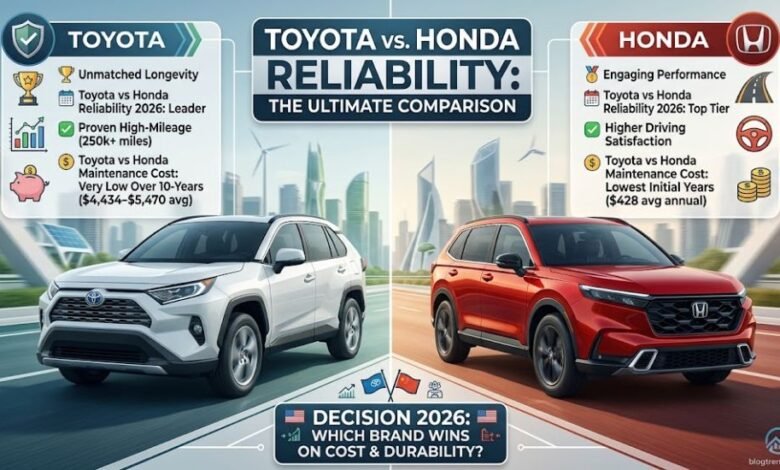
When shoppers compare Japanese automakers, two names almost always appear at the top of the list: Toyota and Honda. Both manufacturers have built strong reputations for producing dependable vehicles, relatively efficient engines, and cars that can remain on the road for many years when properly maintained. But when it comes to Toyota vs Honda reliability, which brand actually has the advantage in 2026?
The answer is not quite as simple as choosing one badge over the other. Toyota has recently held a stronger position in several major reliability rankings, while Honda continues to perform very well and offers several highly dependable models. Maintenance costs, repair frequency, vehicle age, powertrain design, and individual model history can all influence the ownership experience.
For buyers looking for a dependable new car or used vehicle, understanding these differences can make the decision much easier.
Toyota vs Honda Reliability: Quick Overview
Toyota and Honda are both considered among the more reliable mainstream automotive brands. However, recent reliability research generally gives Toyota a slight overall advantage.
Consumer Reports’ latest reliability data places Toyota ahead of Honda in predicted reliability. Toyota has also performed exceptionally well in used-car reliability rankings, reflecting the brand’s reputation for durability over many years.
Honda, meanwhile, remains highly competitive. Models such as the Civic, Accord, CR-V, and HR-V have developed strong reputations for dependable ownership.
The important point is that brand-level rankings do not tell the entire story. A particular Honda can be more reliable than a particular Toyota, and vice versa. Buyers should always investigate the exact model and model year they are considering.
Why Toyota Has Such a Strong Reliability Reputation
Toyota’s reputation for reliability has developed over decades. The company has traditionally emphasized proven engineering, incremental changes, and long-term durability rather than introducing dramatic mechanical changes every few years.
This approach can benefit owners because mature components and powertrains often have extensive development and real-world testing behind them.
Toyota also has a broad range of vehicles, including compact cars, sedans, SUVs, trucks, and hybrids. Some of its best-known models include the Corolla, Camry, RAV4, Highlander, Tacoma, and Prius.
Another major advantage is Toyota’s extensive hybrid experience. The company has been producing hybrid vehicles for many years, giving it a long history with hybrid powertrains.
That does not mean every Toyota is problem-free. Modern vehicles contain increasingly complicated electronics, driver-assistance technology, infotainment systems, and turbocharged engines. These systems can introduce potential problems regardless of manufacturer.
Still, Toyota’s overall track record keeps it near the top of reliability surveys.
Why Honda Is Also Considered Highly Reliable
Honda has an equally impressive reputation among many car owners. Its engines, transmissions, and compact vehicles have historically earned strong reliability ratings.
The Honda Civic is particularly important to the brand’s reputation. It has been produced for generations and is known for efficiency, practicality, and relatively low ownership costs.
The Honda Accord is another long-running model that has attracted buyers looking for a comfortable and dependable midsize sedan.
Honda’s SUV lineup, including the CR-V, has also become increasingly important. For families and daily commuters, the CR-V combines practicality with fuel efficiency and a generally strong reliability record.
Honda’s engineering philosophy differs somewhat from Toyota’s, but both companies share a focus on efficient and durable vehicles.
Toyota vs Honda Reliability 2026: What the Latest Data Says
For Toyota vs Honda reliability 2026, recent third-party reliability research gives Toyota an advantage overall.
Consumer Reports’ latest reliability research placed Toyota at the top of its new-car reliability rankings, while Honda remained among the leading brands. In the same research, Toyota scored higher in predicted reliability than Honda.
This is significant because Consumer Reports gathers reliability information from a very large vehicle-owner population. Its data considers problems reported across numerous vehicle systems and provides a useful picture of expected reliability.
Other research organizations can produce somewhat different rankings because they use different methodologies.
For example, J.D. Power focuses heavily on problems experienced during a defined ownership period, while RepairPal evaluates factors such as repair frequency, repair severity, and ownership costs.
Therefore, there is no single universal reliability score.
The overall pattern, however, is clear: both Toyota and Honda are strong choices, with Toyota currently holding a modest edge in many reliability comparisons.
Toyota vs Honda Maintenance Cost
Reliability is only one part of vehicle ownership. Another major consideration is the Toyota vs Honda maintenance cost.
Routine maintenance generally includes items such as:
- Engine oil and filter changes
- Tire rotation
- Brake inspection
- Brake-pad replacement
- Air-filter replacement
- Cabin-filter replacement
- Fluid inspections
- Battery replacement
- Spark-plug replacement
- Scheduled inspections
The exact cost depends heavily on the model, location, mileage, labor rates, and whether the owner uses a dealership or independent repair shop.
RepairPal estimates Toyota’s average annual repair cost at roughly $441, although actual costs vary substantially by vehicle and owner.
Honda maintenance expenses are also generally competitive with Toyota. Both brands benefit from large dealer networks and widespread parts availability, which can help keep repair expenses manageable.
For many owners, the difference between Toyota and Honda routine maintenance may be relatively small. The larger differences can appear when a vehicle develops an expensive mechanical or electronic problem.
Which Is Cheaper to Maintain: Toyota or Honda?
There is no universal answer because maintenance schedules vary by vehicle.
A Toyota Corolla, for example, may have different maintenance requirements than a Toyota Land Cruiser. Likewise, a Honda Civic will have different service requirements from a Honda Pilot.
Generally, both manufacturers offer relatively reasonable maintenance costs compared with many luxury brands.
Independent repair shops can also reduce ownership costs compared with dealership servicing, although owners should ensure that the correct maintenance schedule and quality parts are used.
When purchasing a used Toyota or Honda, maintenance history may be more important than the small difference between the brands.
A well-maintained Honda with documented service can be a better purchase than a neglected Toyota.
Toyota vs Honda: Which Lasts Longer?
Long-term durability is one of the biggest reasons consumers search for Toyota vs Honda reliability.
Both brands have vehicles capable of reaching high mileage when properly maintained. However, Toyota has a particularly strong reputation for long-term durability, especially among several of its traditionally powered models and hybrid vehicles.
Honda vehicles can also reach very high mileage, particularly when owners follow scheduled maintenance and address problems early.
The biggest factors affecting lifespan include:
- Regular oil changes
- Correct fluid replacement
- Transmission maintenance where required
- Cooling-system maintenance
- Driving conditions
- Accident history
- Rust and environmental exposure
- Quality of previous repairs
- Owner driving habits
- Vehicle-specific reliability history
A reliable brand does not eliminate the need for maintenance.
Toyota vs Honda for Used Cars
Used-car buyers should look beyond the manufacturer’s reputation.
Before buying a used Toyota or Honda, check:
- Complete service records
- Accident history
- Mileage
- Number of previous owners
- Recall history
- Engine condition
- Transmission behavior
- Suspension components
- Brake condition
- Tire age
- Fluid leaks
- Warning lights
- Interior electronics
- Air-conditioning performance
A professional pre-purchase inspection is particularly valuable.
Toyota’s strong resale value can make used Toyotas more expensive than comparable competitors. Honda vehicles can also retain their value well.
Consequently, the cheapest purchase price is not necessarily the cheapest ownership option.
Toyota vs Honda: Cars
Toyota and Honda compete directly in several car categories.
The Toyota Corolla and Honda Civic are among the best-known compact cars from their respective brands.
The Corolla emphasizes practicality, efficiency, and straightforward ownership. The Civic has traditionally focused on a combination of efficiency, driving dynamics, interior space, and technology.
For buyers prioritizing long-term dependability, both can be excellent choices. Toyota may have a slight advantage based on broader current reliability rankings, but the specific model year should be investigated.
In the midsize category, Toyota’s Camry has historically been a major competitor to the Honda Accord. Both have been popular choices for commuters and families.
Toyota vs Honda: SUVs
SUVs have become increasingly important, and both companies offer extensive SUV lineups.
Toyota’s RAV4 is one of the most recognizable compact SUVs in the market. Honda’s CR-V competes directly with it.
Both vehicles offer practical interiors, fuel-efficient options, and strong reputations.
At larger sizes, Toyota offers models such as the Highlander and Grand Highlander, while Honda competes with vehicles including the Pilot.
Again, reliability depends on the particular generation and powertrain.
Consumers should be cautious about assuming that every model from a highly rated brand will automatically be equally reliable.
Toyota vs Honda Hybrid Reliability
Hybrid vehicles are now an important part of both manufacturers’ strategies.
Toyota has an especially long history with hybrid technology. Its Prius became one of the world’s most recognizable hybrid vehicles, and Toyota has expanded hybrid systems throughout its lineup.
Honda also has substantial hybrid experience and has expanded hybrid powertrains into important models.
Hybrid reliability should be evaluated differently from traditional gasoline vehicles because hybrids contain additional components such as electric motors, high-voltage batteries, and sophisticated control systems.
At the same time, hybrid systems can reduce wear on certain components and improve fuel economy.
Toyota’s long history with hybrids gives it a particularly strong reputation in this category, although Honda hybrids should not automatically be considered unreliable.
Common Problems Matter More Than Brand Reputation
One of the biggest mistakes buyers make is treating reliability as a permanent characteristic of a brand.
Automakers introduce new engines, transmissions, electronics, and software. Reliability can therefore change significantly between generations.
A Toyota model from one generation may have an excellent reliability record while a newer generation initially experiences more problems.
The same principle applies to Honda.
Before purchasing, consumers should research the exact vehicle year and powertrain rather than simply searching for “Toyota reliability” or “Honda reliability.”
Owner forums, reliability surveys, recall databases, technical service information, and professional reviews can all provide useful context.
Toyota vs Honda: Resale Value
Resale value is another area where both companies perform strongly.
Toyota vehicles frequently retain value well because of their reliability reputation, strong demand, and large used-car market.
Honda also benefits from strong resale demand, particularly for popular models such as the Civic and CR-V.
A vehicle that retains its value can effectively lower the owner’s total cost of ownership because depreciation is one of the largest expenses associated with buying a new vehicle.
This means that a slightly more expensive Toyota could potentially make financial sense if it retains more value over several years.
Which Brand Is Better for Families?
For families, both Toyota and Honda offer compelling choices.
Honda often receives praise for interior practicality, clever storage solutions, and comfortable passenger space. Toyota provides a broad selection of SUVs, hybrids, and family-oriented vehicles.
Safety technology is also widely available across modern Toyota and Honda vehicles.
Families should compare cargo capacity, rear-seat space, child-seat compatibility, fuel economy, safety ratings, and reliability for the exact models under consideration.
Rather than choosing the brand first, it is usually better to identify the vehicle type and then compare competing models.
Toyota vs Honda: Pros and Cons
Toyota Advantages
- Excellent overall reliability reputation
- Strong long-term durability
- Extensive hybrid experience
- Strong resale values
- Large model lineup
- Wide availability of parts and service
Toyota Disadvantages
- Some models command higher used-car prices
- Newer technology can introduce complexity
- Reliability varies between models and generations
- Some owners may find comparable Honda models more engaging to drive
Honda Advantages
- Strong reliability reputation
- Efficient engines and powertrains
- Popular and practical compact cars
- Strong SUV lineup
- Good resale value
- Competitive maintenance expenses
Honda Disadvantages
- Some model generations have had specific reliability concerns
- Repair costs can vary considerably by model
- Reliability rankings can trail Toyota in some recent surveys
- New technology and powertrain changes can affect long-term reliability
Toyota vs Honda Reliability: Which Should You Buy?
If reliability is your number-one priority in 2026, Toyota has the stronger overall case based on recent reliability research.
However, that does not mean Honda is a poor choice. Far from it.
Honda remains one of the most dependable mainstream automotive brands, and several Honda models can be excellent long-term vehicles.
The best decision depends on the specific vehicle.
For example, someone comparing a Toyota RAV4 and Honda CR-V should examine the reliability records of the exact model years, engines, transmissions, recalls, maintenance schedules, and ownership costs.
Likewise, someone choosing between a Corolla and Civic should compare fuel economy, insurance, purchase price, depreciation, repair costs, comfort, and personal driving preferences alongside reliability.
Final Verdict
So, who wins the Toyota vs Honda reliability comparison?
Toyota takes the overall reliability advantage in 2026, particularly when looking at recent broad-based reliability rankings and its long-standing reputation for durability. Its extensive hybrid experience and strong resale values further strengthen its ownership proposition.
Honda, however, remains an excellent alternative. Its vehicles can provide many years of dependable service when properly maintained, and the difference between the two brands is often smaller than the headline rankings suggest.
For buyers comparing Toyota vs Honda maintenance cost, routine expenses are generally competitive, and the exact model and maintenance history matter greatly. For used vehicles, condition and documented servicing can outweigh the brand difference.
Ultimately, the smartest strategy is to choose a well-maintained vehicle with a strong model-specific reliability record rather than assuming that one manufacturer’s badge guarantees trouble-free ownership.
For more automotive comparisons, ownership guides, and practical vehicle information, blogtrendnews aims to provide readers with useful research-based content to help them make more informed decisions.