United Airlines Flight UA770 Emergency Diversion: What Happened and What We Know

Airline emergencies naturally attract attention, especially when a commercial aircraft changes course unexpectedly during an international journey. One flight that has generated considerable interest online is United Airlines Flight UA770 emergency diversion. Search results contain numerous accounts describing an aircraft declaring an emergency, using the 7700 transponder code, and diverting toward London Heathrow. At the same time, later articles have published conflicting information about the date, route, aircraft type, technical problem, and even whether some versions of the story refer to the same flight.
That makes it important to approach the UA770 story carefully. Rather than repeating every claim found online, this article examines the commonly reported May 27, 2025 event, explains what an emergency diversion means, discusses the role of Squawk 7700, and highlights which details should be treated cautiously.
What Is United Airlines Flight UA770?
UA770 is a United Airlines flight number used for scheduled passenger service. The flight has appeared in online flight-tracking and aviation discussions in connection with a reported emergency diversion.
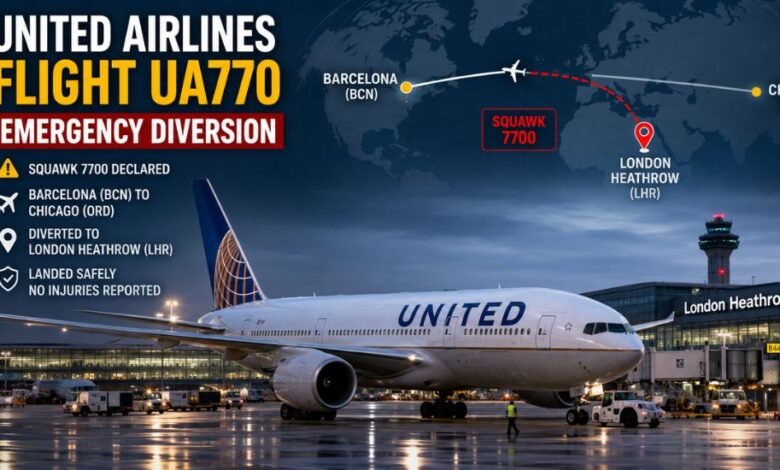
The most widely circulated version of the incident concerns a flight traveling from Barcelona, Spain, to Chicago O’Hare International Airport on May 27, 2025. According to an AIRLIVE report published during the event, the aircraft departed Barcelona, declared a general emergency, and diverted toward London Heathrow. The report identified the aircraft as a Boeing 787 and said it subsequently landed at Heathrow.
However, later websites have disagreed about important details. Some describe the aircraft as a Boeing 787-9, while others identify it as a 787-8. There are also articles that give different dates, routes, causes and diversion airports. Consequently, readers should be careful when treating secondary blog reports as authoritative evidence.
The Reported United Airlines Flight UA770 Emergency Diversion
The most commonly referenced incident occurred on May 27, 2025. According to contemporary reporting, UA770 was operating from Barcelona to Chicago when the crew declared an emergency while the aircraft was in flight.
Instead of continuing toward its original destination, the pilots coordinated with air traffic control and diverted to London Heathrow Airport. AIRLIVE reported that the aircraft used Squawk 7700, the internationally recognized transponder code associated with a general emergency. The same report stated that the aircraft subsequently landed on Heathrow’s Runway 27R and proceeded to a gate.
The decision to divert does not automatically mean an aircraft was in immediate danger of crashing. In commercial aviation, crews can declare an emergency when they want priority handling or additional support because a technical condition, medical situation, weather issue, or another concern requires a safer alternative to continuing the original flight.
A diversion is often a precautionary safety decision.
What Does Squawk 7700 Mean?
One of the most recognizable details associated with the United Airlines Flight UA770 emergency diversion is the reported use of the number 7700.
Aircraft communicate with air traffic control through radio and transponder systems. A transponder code, commonly called a “squawk,” allows controllers to identify and track aircraft. Certain codes have special meanings.
Squawk 7700 is used to indicate a general emergency. It alerts air traffic controllers that an aircraft requires attention and potentially priority handling.
Importantly, Squawk 7700 does not tell observers exactly what has gone wrong.
It does not necessarily mean an aircraft is about to crash, nor does it identify whether the problem involves the engines, cabin systems, weather, passengers, medical issues, or another part of the operation. It is essentially an emergency signal that prompts air traffic services to give the flight appropriate attention.
Therefore, seeing UA770 associated with 7700 does not by itself establish a particular mechanical failure.
What Can Lead to a Diversion During a Long-Haul Flight?
A long-haul flight crossing international airspace has numerous alternate airports available. Pilots and airline operations teams consider these options when deciding whether to continue or divert.
Factors can include:
- The nature of the reported problem
- Aircraft fuel remaining
- Weather at potential airports
- Runway availability
- Airport operating hours
- Air traffic conditions
- Airport emergency services
- Distance to suitable airports
- Passenger and crew considerations
- Maintenance and technical support
A pilot may therefore choose a major international airport even when another airport appears geographically closer.
London Heathrow is one of Europe’s major aviation hubs. Its extensive infrastructure, multiple runways, emergency resources, maintenance capabilities and international connectivity can make it an attractive destination when an aircraft needs to make an unscheduled landing.
Was There a Cabin Pressurization Problem?
This is one of the areas where online coverage becomes particularly difficult to verify.
Several articles published after the reported event claim that the aircraft experienced a cabin pressurization warning. Some versions say the alert occurred while the aircraft was cruising at high altitude and prompted the crew to divert.
Other websites, however, provide different explanations, including generic technical problems, sensor alerts, hydraulic concerns and other mechanical descriptions. A review of the available online material shows that these accounts do not agree with one another.
For that reason, it is safer to describe cabin pressurization as a reported explanation rather than an officially established cause.
This distinction matters. A warning from a monitoring system does not necessarily mean that a major component has failed. Aircraft systems contain multiple sensors, warning mechanisms and backup procedures. Flight crews are trained to respond to abnormal indications conservatively.
Why Cabin Pressurization Matters
Cabin pressurization is essential during high-altitude commercial flight.
At cruising altitude, the outside air pressure is much lower than at sea level. A passenger aircraft therefore maintains a controlled cabin environment so people can breathe comfortably and safely.
If there is a confirmed or suspected problem with pressurization, pilots have established procedures for dealing with it. Depending on the circumstances, the aircraft can descend to a lower altitude, use emergency oxygen systems if required, or divert to an appropriate airport.
This is one reason why pilots may choose to make an emergency declaration even when passengers do not see anything dramatic inside the cabin.
A diversion can be the result of preventive decision-making rather than an actual catastrophe.
The Reported Landing at London Heathrow
According to the contemporary AIRLIVE report, United Airlines confirmed that UA770 was diverting to London Heathrow. The report later stated that the aircraft landed on Runway 27R and moved to Gate B44.
Other later articles repeat a similar sequence and describe the landing as safe, with no injuries reported.
That outcome is consistent with how emergency diversions are intended to work.
Once an aircraft declares an emergency, air traffic controllers can prioritize its movement. Airport personnel can prepare emergency equipment, ground crews can be alerted, and the flight crew can focus on managing the situation and completing a controlled approach.
The fact that an aircraft lands safely after declaring an emergency should therefore not be interpreted as evidence that the emergency was fabricated. Emergency procedures exist precisely to manage uncertain situations before they become more serious.
What Happened to Passengers?
Passenger experience during an emergency diversion can vary considerably.
Some travelers may notice only a change in the flight path or an announcement from the crew. Others may become aware of an emergency declaration through flight-tracking applications or information circulating online.
After an unexpected landing, passengers may have to wait while airline personnel inspect the aircraft and determine whether it can continue. Depending on the technical situation, travelers may be rebooked onto another aircraft or another flight.
Several secondary reports associated with UA770 claim that passengers were accommodated and rebooked after the Heathrow diversion, although detailed passenger-service information is not consistently documented across reliable sources.
For that reason, specific claims about hotel arrangements, meal vouchers, compensation or exact passenger numbers should not be treated as universally confirmed unless supported by United Airlines or another authoritative source.
Why Are There So Many Conflicting UA770 Stories?
One of the most interesting aspects of this topic is the amount of contradictory information available online.
Some pages describe the May 27 flight from Barcelona to Chicago. Others associate UA770 with different American routes and different diversion airports. Aircraft descriptions also vary.
A recent investigation into the search results found that websites had published contradictory dates, routes, diversion airports and alleged causes. It concluded that there was no consistent primary-source trail supporting all of the details circulating online.
This is particularly important for anyone researching aviation incidents.
Flight numbers are not permanent identifiers for one specific aircraft. Airlines reuse flight numbers on scheduled services. The same flight number can therefore refer to different physical flights on different days.
A later article can mistakenly combine information from different operations and create a story that appears detailed but is actually a mixture of unrelated events.
How to Verify an Aviation Emergency
The UA770 controversy provides a useful lesson in online research.
When investigating an aviation incident, readers should compare several types of sources rather than relying on a single blog.
Useful sources include:
- Airline statements – The operating airline is one of the most important sources for confirmed information.
- Aviation regulators – Government aviation authorities can provide official incident information.
- Flight-tracking data – Flight trackers can help verify routes, diversions and aircraft movements.
- Established aviation publications – Specialist aviation outlets can provide operational context.
- Major news organizations – Independent reporting can help confirm significant incidents.
- Airport information – Airports can sometimes confirm unscheduled arrivals or operational disruptions.
If five websites repeat exactly the same sentence but all appear to have copied it from one another, that does not necessarily mean the information has been independently verified.
Does an Emergency Diversion Mean the Flight Was Unsafe?
Not necessarily.
Commercial aviation operates on the principle that potential problems should be handled before they become serious. Pilots are not expected to wait until a situation becomes catastrophic before taking action.
A crew may divert because a warning light appears, a system behaves unexpectedly, a passenger experiences a serious medical issue, weather deteriorates, or maintenance concerns arise.
In many cases, the safest decision is simply to land at a suitable airport and investigate the problem on the ground.
That is why the term “emergency diversion” can sound more dramatic to the public than it is operationally. An emergency declaration is a serious matter, but it is also a normal component of aviation safety procedures.
What UA770 Teaches Travelers About Flight Emergencies
For passengers, the biggest lesson from the UA770 discussion is that unexpected diversions are part of air travel.
Travelers should avoid relying exclusively on social media posts or sensational headlines when an aircraft changes direction.
If a flight diverts, passengers should listen carefully to cabin announcements, follow crew instructions, keep important travel documents accessible and wait for official information about onward travel.
Passengers can also check the airline’s official flight-status information rather than assuming that a third-party post provides the complete story.
Most importantly, travelers should remember that a diversion is generally a safety response. The aircraft is being taken to an airport judged more suitable for the circumstances.
United Airlines Flight UA770 Emergency Diversion: Final Perspective
The United Airlines Flight UA770 emergency diversion remains a topic of significant online interest because the available reports combine a dramatic emergency declaration, Squawk 7700 and an unexpected diversion to London Heathrow. The most widely circulated account describes a May 27, 2025 Barcelona-to-Chicago service that diverted safely to Heathrow after declaring an emergency. Contemporary reporting supports the diversion and landing, while later online articles disagree over several technical and operational details.
The biggest takeaway is therefore not simply what supposedly went wrong on UA770, but how important reliable aviation information is. Details such as the aircraft variant, exact technical fault, passenger count and underlying cause should be treated carefully when they come from secondary websites that contradict one another. A responsible account should distinguish between reported information and independently confirmed facts.
For readers of blogtrendnews, the UA770 story is also a useful reminder that aviation emergencies are usually handled through layers of preparation, communication and professional decision-making. An unexpected diversion may sound frightening, but choosing to land at a suitable airport can be exactly what a well-trained flight crew is supposed to do when something unusual occurs.