Small Wind Turbine for Home: Prices, Best Options and Complete Guide in Pakistan

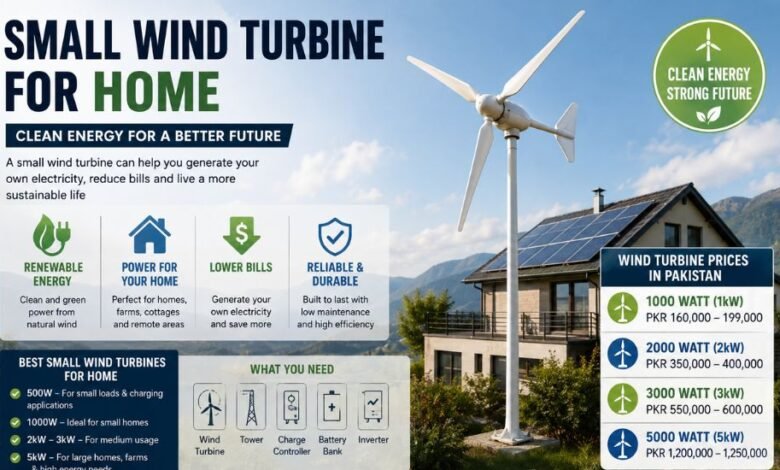
A small wind turbine for home can be an interesting renewable-energy solution for households looking to generate electricity from wind. Unlike solar panels, which depend on daylight, a wind turbine can produce power whenever suitable wind is available, including during the night. However, choosing the right turbine requires more than simply looking at its wattage or advertised price. Wind speed, tower height, installation location, battery capacity, inverter type, maintenance requirements, and local conditions all affect the performance of a residential wind-energy system.
In Pakistan, interest in small wind turbines is growing, particularly in windy coastal and open areas. People searching for a small wind turbine for home price in Pakistan, a 1000 watt wind turbine price in Pakistan, or a 5kw wind turbine price in Pakistan should understand that online prices can vary significantly depending on the manufacturer, specifications, accessories, and installation package.
What Is a Small Wind Turbine for Home?
A small wind turbine is a compact electricity-generating machine designed to convert the energy of moving air into electrical power. Its blades rotate when wind passes through the rotor, causing a generator to produce electricity. The electricity can then be used directly, stored in batteries, or converted through an inverter for household appliances.
The U.S. Department of Energy explains that a small wind system generally consists of a rotor, generator, tower, wiring, controllers and other electrical equipment. Off-grid systems may also require batteries and an inverter.
For residential use, turbines are commonly available in capacities such as:
- 300W
- 500W
- 1kW or 1000W
- 2kW
- 3kW
- 5kW
The appropriate size depends on the home’s electricity requirements and, most importantly, the wind conditions at the installation site.
How Does a Home Wind Turbine Work?
The operating principle is relatively simple. Wind pushes the turbine blades, causing the rotor to spin. The rotating shaft drives a generator, which produces electrical energy. A controller manages the electricity before it reaches batteries or an inverter.
A typical home wind-energy system may include:
- Wind turbine
- Rotor and blades
- Generator
- Tower
- Wind charge controller
- Inverter
- Battery bank for off-grid applications
- Cabling
- Electrical protection
- Foundation or mounting structure
The turbine’s rated capacity does not mean it will generate that amount of electricity continuously. For example, a 1000W wind turbine can reach its rated output only under appropriate operating conditions. Actual electricity production changes with wind speed.
This distinction is important when comparing turbines because a larger number printed on the product does not automatically mean better real-world performance.
Best Small Wind Turbine for Home
The best small wind turbine for home is not necessarily the largest or most expensive model. The best choice is the one that matches the property’s wind resource, electricity needs and available installation space.
500W Wind Turbine
A 500W turbine can be considered for relatively small applications such as:
- LED lights
- Battery charging
- Small electronic devices
- Low-power fans
- Backup lighting
It may be suitable for users who want to experiment with residential wind generation without investing in a large system.
1000W Wind Turbine
A 1000W or 1kW turbine is a more practical option for small-scale residential applications when the site has sufficient wind.
It can potentially support smaller household loads and battery charging. However, users should not expect a 1kW turbine to continuously power an entire home.
A Pakistan-focused pricing guide currently places a 1kW turbine in the approximate PKR 160,000–199,000 range, although actual market prices can differ according to the model and included components.
2kW to 3kW Wind Turbines
These models can provide substantially more generating capacity than a 1kW turbine and may be considered for homes with greater electricity requirements.
They require a suitable tower, stronger supporting infrastructure and a better wind resource. Before purchasing, homeowners should calculate their expected electricity consumption and compare it with the turbine’s estimated energy production.
5kW Wind Turbine
A 5kW turbine is intended for significantly higher electricity production. It can be considered for large homes, farms, offices or other properties where wind conditions justify the investment.
A Pakistan-based supplier’s July 2026 pricing guide lists 5kW turbines at approximately PKR 1.2 million to PKR 1.25 million, while its product listings show some 5kW models at lower prices. This difference demonstrates why buyers should verify the exact model, package and included equipment before making a purchase.
1000 Watt Wind Turbine Price in Pakistan
The 1000 watt wind turbine price in Pakistan varies considerably depending on specifications and supplier.
A commonly cited Pakistan market guide gives an approximate price of PKR 160,000–199,000 for a 1kW turbine. Other online listings and product examples can be considerably cheaper or more expensive, particularly when shipping, controllers, towers or installation are included.
Therefore, buyers should avoid judging a product only by its advertised price.
When comparing a 1000W turbine, check:
- Rated voltage
- Generator type
- Blade material
- Number of blades
- Starting wind speed
- Rated wind speed
- Controller type
- Tower availability
- Warranty
- Installation cost
- Shipping charges
- Battery compatibility
A low-cost turbine may initially look attractive but become expensive after adding a tower, controller, inverter, batteries and installation.
Small Wind Turbine for Home Price in Pakistan
The small wind turbine for home price in Pakistan depends primarily on capacity and system configuration.
Indicative prices from a Pakistan-focused supplier are approximately:
| Turbine Capacity | Indicative Price |
|---|---|
| 500W | PKR 75,000–100,000 |
| 1kW | PKR 160,000–199,000 |
| 2kW | PKR 350,000–400,000 |
| 3kW | PKR 550,000–600,000 |
| 5kW | PKR 1,200,000–1,250,000 |
These figures should be treated as indicative online prices rather than fixed nationwide retail prices. Product prices can change according to brand, imported or locally manufactured components, exchange rates, shipping, tower specifications and accessories.
Another important consideration is that a turbine price often does not represent the complete installed system.
5kW Wind Turbine Price in Pakistan
The 5kw wind turbine price in Pakistan is generally much higher than that of smaller residential models.
One Pakistan supplier’s 2026 guide gives a price of roughly PKR 1.2 million or more for certain 5kW systems. Its listed specifications for a typical model include a permanent-magnet generator, three blades, multiple voltage options and an MPPT wind charge controller.
The supplier also indicates that some quoted prices exclude major components such as:
- Batteries
- Inverter
- Tower
- Wiring
- Installation
Consequently, someone searching for the 5kw wind turbine price in Pakistan should distinguish between the turbine-only price and the complete installed system cost.
A complete project can cost considerably more after adding the tower, foundation, electrical equipment, batteries and labour.
How Much Electricity Can a 5kW Wind Turbine Produce?
A 5kW turbine does not automatically generate 5kWh every hour. The actual output depends on wind conditions.
A supplier’s estimates show that production can increase substantially as average wind speed rises, with its example figures ranging from roughly 120–240 kWh per month at lower wind speeds to more than 1,000 kWh per month under much stronger conditions. These are estimates and should not be interpreted as guaranteed output.
The U.S. Department of Energy similarly emphasizes the importance of the site’s annual average wind speed and turbine power curve when evaluating a small wind system.
This is why a properly positioned smaller turbine can sometimes outperform a larger turbine installed in a poor location.
Why Wind Speed Matters So Much
Wind speed is one of the most important factors when buying a turbine.
The amount of energy available in wind increases approximately with the cube of wind velocity. In simple terms, a modest increase in wind speed can produce a much larger increase in available wind energy.
For this reason, a location that occasionally experiences strong gusts may not necessarily be suitable for a home wind turbine. A useful wind resource should be reasonably consistent rather than limited to short periods.
The U.S. Department of Energy recommends assessing the actual wind resource at the proposed site before installing a small wind system. Terrain, trees, buildings and other obstacles can create turbulence and reduce performance.
Can You Install a Small Wind Turbine on Your Roof?
Roof-mounted wind turbines are often promoted as convenient residential solutions, but the roof is not always the best location.
Buildings can interfere with airflow and create turbulence. Turbulent wind can reduce energy production and increase mechanical stress on the turbine.
A properly designed tower placed in an open area can provide cleaner airflow than a turbine mounted close to buildings.
Before installation, homeowners should consider:
- Nearby buildings
- Trees
- Roof structure
- Wind direction
- Tower height
- Property boundaries
- Noise
- Vibration
- Safety
- Foundation requirements
A qualified installer should evaluate the proposed location before construction.
Vertical vs Horizontal Small Wind Turbines
Two common turbine designs are horizontal-axis wind turbines (HAWTs) and vertical-axis wind turbines (VAWTs).
Horizontal-Axis Wind Turbine
Horizontal-axis turbines use propeller-like blades mounted around a horizontal rotor.
Advantages include:
- Established technology
- Strong performance at suitable wind speeds
- Wide availability
- Suitable for open areas
They generally benefit from a clear, unobstructed wind resource.
Vertical-Axis Wind Turbine
Vertical-axis turbines have a rotor arranged vertically and are often marketed for locations where wind direction changes frequently.
Potential advantages include:
- Compact design
- Different installation possibilities
- Wind can approach from multiple directions
However, buyers should still evaluate the turbine’s actual power curve and efficiency rather than choosing a vertical model simply because it looks more convenient.
Small Wind Turbine vs Solar Panels
For many Pakistani households, the most important question is not whether wind power works, but whether it is the most economical renewable-energy option for their specific property.
Solar panels are often easier to install because they have no large moving blades and generally require less mechanical maintenance. Wind turbines, on the other hand, can potentially generate electricity at night when suitable wind is available.
A hybrid solar-and-wind system can therefore be attractive in locations with both good solar exposure and consistent wind.
However, homeowners should compare the expected annual energy production and total installation cost before choosing one technology over another.
Additional Costs to Consider
The turbine itself is only one part of a residential wind system.
Other expenses can include:
Tower
The tower provides the height needed to reach better wind conditions. A taller tower can improve wind access but also increases structural and installation requirements.
Controller
The controller regulates power from the turbine and helps manage battery charging in off-grid systems.
Inverter
An inverter may be necessary to convert generated electricity into the appropriate form for household appliances.
Batteries
Off-grid systems generally need batteries to store electricity for periods when wind generation is low.
Installation
Installation may involve transportation, tower erection, foundation construction, electrical connections and safety equipment.
Maintenance
Unlike solar panels, wind turbines have moving mechanical parts. Bearings, blades, electrical connections and other components may eventually require inspection or replacement.
Advantages of a Small Wind Turbine for Home
A residential wind turbine can offer several benefits:
- Renewable electricity generation
- Potential reduction in grid electricity consumption
- Generation can occur during nighttime
- Useful for off-grid locations
- Can complement solar panels
- Suitable for farms and open properties
- Long-term energy-generation potential
For homes in genuinely windy areas, these advantages can make a small wind system worthwhile.
Disadvantages of Home Wind Turbines
There are also important limitations:
- Performance depends heavily on wind conditions
- Installation can require a tower
- Initial costs can be high
- Moving components require maintenance
- Poor locations can produce disappointing output
- Turbulence can reduce efficiency
- Batteries and inverters add to system costs
- Noise and vibration may need consideration
These factors explain why a wind turbine should be selected after evaluating the property rather than simply buying the highest-wattage model.
Is a Small Wind Turbine Worth It in Pakistan?
A small wind turbine can be worthwhile in Pakistan when it is installed at a site with adequate and consistent wind.
Coastal and open areas of Sindh and Balochistan can offer interesting opportunities for wind energy. Areas associated with Pakistan’s established wind-energy development include locations around Jhimpir, Gharo, Thatta and parts of the coastline. A supplier also identifies Karachi, Gwadar and other coastal areas as potentially suitable locations.
Nevertheless, geographic location alone does not guarantee that an individual property will produce enough electricity. A site-specific wind assessment remains essential.
Tips for Buying the Best Small Wind Turbine for Home
Before purchasing, follow these basic steps:
First, measure or investigate the wind resource. Do not purchase a turbine simply because the area is known to be windy.
Second, calculate your electricity requirement. Determine how many appliances you want the system to support.
Third, compare energy production rather than rated wattage. Examine the turbine’s power curve and expected annual output.
Fourth, ask what is included in the quoted price. Confirm whether the tower, controller, inverter, batteries, wiring and installation are included.
Fifth, check warranty and spare parts. A turbine is a mechanical device, so replacement components and technical support matter.
Finally, compare the complete system cost. A cheap turbine may become expensive once all additional equipment is included.
Final Thoughts
A small wind turbine for home can provide clean electricity and may be especially useful in areas with strong, consistent wind. For smaller applications, a 500W or 1kW turbine can be considered, while 2kW, 3kW and 5kW models are better suited to properties with greater energy requirements and adequate wind resources.
When researching the 1000 watt wind turbine price in Pakistan, buyers may encounter prices around PKR 160,000–199,000 from current online Pakistan-focused pricing information. For a 5kw wind turbine price in Pakistan, indicative prices can reach roughly PKR 1.2 million or more, although product listings show that prices vary considerably between models and packages.
The most important lesson is that bigger is not always better. Wind speed, tower placement, turbine quality and total system design ultimately determine how much useful electricity a home wind turbine can produce. Anyone considering a purchase should evaluate the site carefully and obtain a complete quotation before investing.
For readers of blogtrendnews, understanding these factors can make it easier to compare residential wind turbines, evaluate Pakistan market prices and decide whether wind power or a solar-wind hybrid system makes sense for a particular property.
small wind turbine for home options, prices, 1kW and 5kW turbine costs in Pakistan, benefits, installation tips, and how to choose the right system.